Extra work can be profitable, but undocumented changes can turn a straightforward building job into a disagreement about scope, price and timing. This guide sets out a practical process for UK builders and tradespeople to price a proposed variation, explain it to a customer and keep a clear approval trail. It is general business information, not legal advice.
Why variations need a written process
A building variation is a change to the agreed work after the original scope has been accepted. It might be an extra socket, a different finish, a concealed repair discovered during demolition or a change requested by the homeowner. Each can affect materials, labour, sequencing and the completion date. The commercial risk is not simply forgetting to charge for an extra item. It is allowing two people to hold different expectations about what has been agreed. A clear variation record makes the decision visible before work proceeds.
Start with the original agreed scope
Keep the accepted quote, drawings, specification, exclusions and any relevant messages together. When someone requests a change, compare it with that baseline rather than relying on memory. Is the requested work genuinely outside the original scope? Is it correcting defective work that the contractor should already put right? Is it an allowance that was always subject to final selection? Those questions matter because an extra invoice is not automatically justified merely because the work took longer than expected. Where responsibility is disputed, record the facts and seek advice rather than presenting an uncertain charge as settled.
Describe the change in plain English
Give each proposed variation a unique reference, such as V-003, and a short description that the customer can recognise. Record the location, materials, dimensions, finish and what is excluded. Photographs and marked-up drawings can help, provided they show the actual site rather than a generic stock example. State why the change arose and who requested it. For hidden conditions, explain what was discovered, what options exist and what happens if no decision is made. Avoid vague entries such as additional building works or miscellaneous extras.
Price the extra work from the bottom up
Estimate the extra labour hours by role, materials at the expected purchase cost, waste, plant, subcontractors, travel and disposal. Then consider additional overhead recovery and the margin needed for the business. Do not assume that the difference between two selling prices equals the difference between two costs. If a changed material removes an original item, show the credit separately. If the work disrupts another trade, include the reasonably anticipated effect and explain the assumption. A variation should be understandable as a change from the original agreement, not a second unexplained quote.
A worked variation example
Suppose a homeowner asks for two extra internal sockets before plastering. For illustration only, the contractor estimates four electrician hours at an internal modelled labour cost of £32 per hour, £46 of materials and £18 of associated consumables. Direct modelled cost is therefore £192. Adding an illustrative £28 overhead allocation produces £220 of estimated cost. A proposed selling price of £275 before any applicable VAT would leave £55 before tax and other unmodelled adjustments. These are fictional figures, not UK market rates or a recommendation for electrical pricing. Check qualifications, testing, access and the actual site conditions before quoting.
Explain VAT, allowances and uncertainty
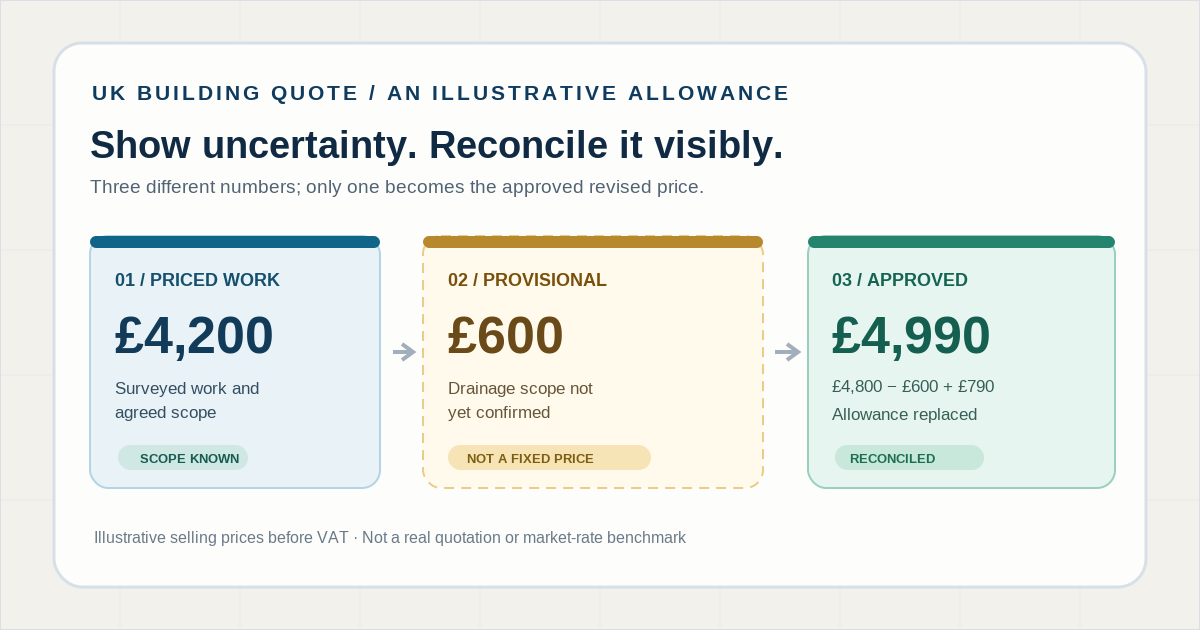
Tell the customer whether the variation price includes VAT, excludes VAT or is subject to a clearly stated treatment. VAT rules depend on the work and the supplier's circumstances; do not infer a rate from a headline example. If the job is not fully exposed, offer a defined provisional allowance with a decision point, rather than suggesting the price is fixed when it is not. Show any credits and revised totals. A short breakdown is usually more useful than a single lump sum because it gives the customer a fair opportunity to ask questions.
Get approval before carrying out the change
Send the written description, price, VAT treatment and any effect on programme before starting the extra work whenever reasonably possible. Ask for an explicit approval that identifies the variation reference and version. A signed variation, a reply to a clearly identified email or another reliable written record may help demonstrate the customer's decision, but the legal position depends on the contract and circumstances. Do not treat silence as approval. For urgent safety work, document the immediate risk, explain what cannot wait and obtain the clearest practicable instructions.
Keep the programme impact separate from price
A small-looking change can affect lead times, access, inspections and other trades. State whether the requested work changes the expected completion date and what assumptions support that estimate. If the effect is not yet known, say so and set a review date. Do not promise an exact new finish date without checking the sequence. Where the contract has formal notice requirements, follow those requirements and keep evidence of when notices were sent.
Use a variation register
A simple register can include reference, request date, requester, scope summary, estimated cost, customer price, VAT treatment, approval status, decision date, programme effect and invoice status. Distinguish proposed, approved, rejected and completed items. Review it with the customer at sensible intervals so a pile of minor requests does not become a surprise at the final invoice. The register also helps the business reconcile approved changes with purchase orders and labour records.
Understand the consumer-contract context
For domestic work, consumer law and fair contract terms can be relevant. A contractor should not assume that a blanket clause allows any additional charge without a fair and transparent basis. The UK government's guidance on unfair contract terms provides useful background, but it is not a substitute for advice on a particular dispute. Where the work falls under a specialist construction contract or a formal variation clause, follow that agreed procedure and seek professional advice when necessary.
A practical approval checklist
Before marking a variation approved, confirm the scope is distinguishable from the original agreement; the price includes credits and stated assumptions; VAT is addressed; timing implications are recorded; the customer has seen the exact version; and the decision is retained with the job record. If any item is missing, resolve it while the change is still proposed. Clear documentation protects both parties by making it easier to say yes, no or please revise.
Connect variations to the original quote
The most useful workflow is one in which the accepted scope, cost build-up and customer decision remain easy to find. Review the difference between a quote and an estimate before pricing uncertain work, and use the construction quote template to structure a clear revised price. CostForge supports quote items, staff-rate costing, branded client PDFs and customer quote acceptance. It is sensible to confirm how you will record contract variations in your own workflow rather than assume the platform supplies a dedicated variation-management module. You can create a CostForge account to explore the supported quoting process.
The takeaway
Good variation control is a sequence: identify the difference, describe it, price it, disclose the effect, obtain a clear decision and update the record. It is not about making paperwork for its own sake. It is about giving a customer a fair choice and giving the business a defensible basis for delivering and charging for work that was not part of the original agreement.