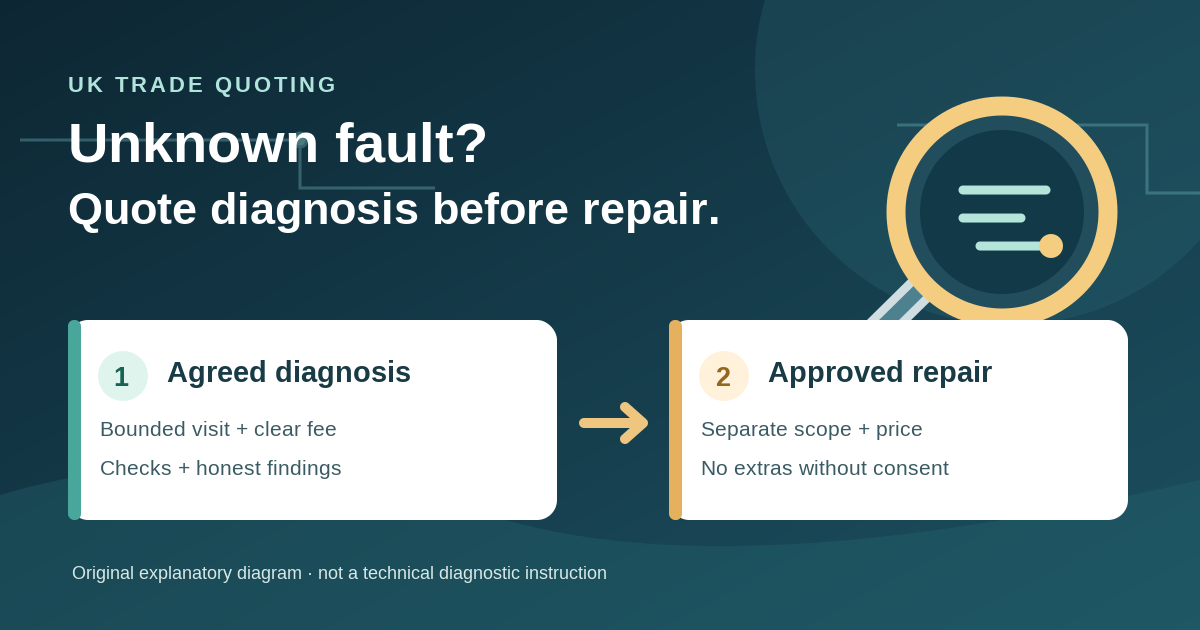
When a fault's cause is unknown, quote the investigation first and the repair second. A tripping electrical circuit, unexplained water leak or intermittent heating fault cannot responsibly be priced as a fully specified repair before the cause and necessary work are identified. A UK trade quote can instead define an initial diagnostic visit, its fee and time limit, what findings the customer will receive, and the approval needed for further investigation or repair.
That approach makes uncertainty visible without making the customer agree to an open-ended bill. It also gives them a useful result if the cause cannot be established at the first visit. The examples here are fictional cost calculations, not national price averages, actual client work or safety instructions.
1. Record the symptom, not a guessed solution
Someone reporting “the upstairs sockets keep tripping” has described a symptom. They have not defined whether the issue is an accessory, appliance, damaged cable or intermittent condition that may not appear while an engineer attends. Likewise, a leak may be a visible connection or a concealed pipe beneath finished surfaces. The safe investigation and repair scope differ.
Before quoting, record where the issue occurs, how frequently, the reported history, any work already attempted, access restrictions, photos if helpful and whether the customer has reported an immediate hazard. Explain what can and cannot be inferred from that information. If the facts support a clearly defined repair, a conventional itemised quotation may be appropriate. If not, use a bounded diagnosis stage rather than presenting a speculative fixed price.
2. Describe the first diagnostic visit as paid work
A diagnostic visit should have an agreed scope and deliverable. Specify the address and accessible systems being assessed, the appointment, the maximum initial on-site time, suitable examination or testing, and a written or emailed summary of findings and next steps. Describe whether limited adjustments are in scope, but do not assume replacement parts or significant remedial work are included.
List material exclusions: opening walls or floors, extensive dismantling, specialist testing or lifting equipment, replacement fittings, making good, additional visits and third-party attendance unless agreed. An exclusion describes the boundary of an agreed service; it does not excuse poor workmanship. If invasive access may be essential, describe its likely consequences and obtain separate approval before it begins.
The UK electrician quote template gives a useful starting structure for scope, testing assumptions, exclusions and commercial terms. Adapt it to the actual trade and fault rather than relying on a general “repair as necessary” line.
3. Choose a clear fee, not an unlimited call-out
A fixed initial diagnostic fee can cover a bounded visit and specified tasks. Alternatively, a time-based fee may be clearer when testing could take longer, provided the rate, minimum, increments and agreed stopping threshold are visible. A cap on the first stage is a ceiling on the authorised work, not a promise that the fault will be located within that time.
Say whether travel is included in a call-out fee or separately charged. If the call-out covers the first period of labour, do not bill the same minutes again. State how much additional testing time would cost and require approval before exceeding the cap. Avoid vague “plus extras” wording. Where a household customer books remotely or agrees work at home, check any applicable consumer-contract information and cancellation duties rather than assuming every emergency or call-out is exempt.
Start with your real labour and overhead model. The labour cost calculator helps separate paid hours, direct cost, travel and overhead before you choose a selling price. Other businesses' advertised call-out rates cannot establish your own job cost.
4. Worked example: an intermittent electrical fault
Illustrative scenario only: A suitably competent electrical contractor receives a request to investigate intermittent circuit tripping. The cause is unknown. The first agreement includes up to two hours of accessible on-site testing and a short findings report. Internal labour cost is assumed to exclude overhead, and VAT is omitted to keep the arithmetic readable. These amounts are not suggested consumer prices.
| Initial investigation item | Illustrative calculation | Cost |
|---|---|---|
| On-site investigation | 2 hours × £28 direct labour cost | £56.00 |
| Booking and written findings | 0.5 hours × £28 | £14.00 |
| Travel and parking | Assumed direct cost | £16.00 |
| Test consumables | Assumed allowance | £6.00 |
| Business overhead | Not already included in £28/hour | £24.00 |
| Total modelled investigation cost | £56 + £14 + £16 + £6 + £24 | £116.00 |
| Illustrative markup on cost | 25% × £116 | £29.00 |
| First-stage selling price before VAT | £116 + £29 | £145.00 |
The £29 uplift is a 25% markup on cost, but 20% of the £145 selling price, so it is not a 25% gross margin. Check the distinction with the markup and margin calculator. The £145 applies to the agreed diagnostic service, not a guaranteed completed repair or unlimited further testing.
Suppose that visit identifies remedial work the contractor can now specify. A separate fictional repair estimate might consist of 2.5 labour hours at £28 (£70), £38 parts, a £16 additional journey and £28 overhead. That is £152 modelled cost; adding a 25% cost markup of £38 produces a £190 repair quote before VAT. If both stages are accepted and completed, the combined example is £145 + £190 = £335 before VAT. If the repair happens on the first visit, remove costs for an unnecessary extra journey or time already included: do not double charge simply because two estimates were written.
5. Explain the boundary in the customer-facing quote
Example wording to adapt to the real job: “Investigate reported intermittent tripping on the identified accessible circuit(s), including up to two hours of on-site fault-finding and a written summary. This fee covers the investigation, not guaranteed identification of an intermittent cause, concealed cable access, replacement parts, making good or remedial installation. We will explain any further work and request approval of its scope and price before proceeding.”
Add the service address, visit date, agreed price, VAT treatment, payment arrangements and the way the customer accepts. State what happens if the issue does not appear during attendance. Don't suggest that a safety concern automatically authorises unlimited extra charges; follow relevant safety obligations and explain what is required.
6. Report what was found and ask for a new decision
Useful diagnostic notes record what was observed, accessible parts examined, tests actually performed, meaningful limitations, the likely causes remaining and recommended next steps. Avoid declaring equipment safe or a defect cured if that conclusion is not supported. For an intermittent problem, further monitoring or specialised testing may be more appropriate than replacing parts on a guess.
Offer a choice: end after the report; approve another defined investigation stage; or accept an itemised repair quote covering labour, parts, access, testing, waste, making good and timescale. If an option is urgent for safety reasons, state the factual reason without manipulating the customer. Save the decision and issue a revised quote if the scope changes.
The building variations guide explains how to document additional work after an agreement. For jobs where the repair was known from the outset, the electrical quoting guide covers a standard scope-and-price workflow.
7. Keep safety and consumer duties separate from commercial uncertainty
Price uncertainty does not relax trade competence. Electrical work must be undertaken by competent people, with testing or certification suitable for the activity. Gas work within the relevant statutory scope requires an appropriately qualified, Gas Safe registered engineer, as HSE explains. This article is about commercial scoping, not how to work on live services or carry out technical diagnosis.
In consumer service contracts, section 49 of the Consumer Rights Act 2015 requires reasonable care and skill. Section 51 provides for a reasonable price in specified circumstances when neither a price nor a way to determine it has been agreed. These rules do not make every requested amount automatically payable. Clear informed agreement, fair terms and proper documentation are important; get legal advice if disputed or unusual circumstances arise.
8. Treat VAT and repeat visits consistently
Say whether the first-stage and later repair prices include VAT where applicable, and apply the treatment correct for the actual work and business. GOV.UK explains the possible treatments in its VAT rates guidance. Do not assume every domestic repair is zero-rated. The worked examples exclude VAT only to isolate the cost and markup calculations.
Store the signed or otherwise recorded first-stage approval, time log, test findings, proposed repair scope, revised quote and further approval together. If the original visit already covered travel or labour, account for that before pricing an immediate repair. If the customer declines the next stage, explain what happened and what amount is due for the agreed investigation, without implying that a fault must always have been found.
9. Final fault-finding quote checklist
- Known facts: reported symptoms, history, property, access, risks and inspection limitations recorded.
- Visit scope: tests or assessment included, maximum initial time and written findings specified.
- Fee model: minimum charge, rate, travel, VAT position and maximum authorised spending clear.
- Exclusions: concealed access, replacement materials, major remedial works and making good described fairly.
- Stop point: further investigation or repair requires a fresh decision with costs explained.
- Record: findings, approval, any revised quote and costs already covered kept together.
Do not sell certainty the available site evidence cannot support. Price the investigation you can define, report honestly on the outcome, and then quote the next piece of work that the evidence supports.
CostForge supports client and job records, nested quote items, labour-role hours, internal margin, branded customer quote PDFs and signed online accept-or-decline responses. It is not diagnostic software, a certification service or a full accounting or project-management suite. Once the work and numbers are ready, you can Create a CostForge account to organise the quote. A click does not establish a completed registration.