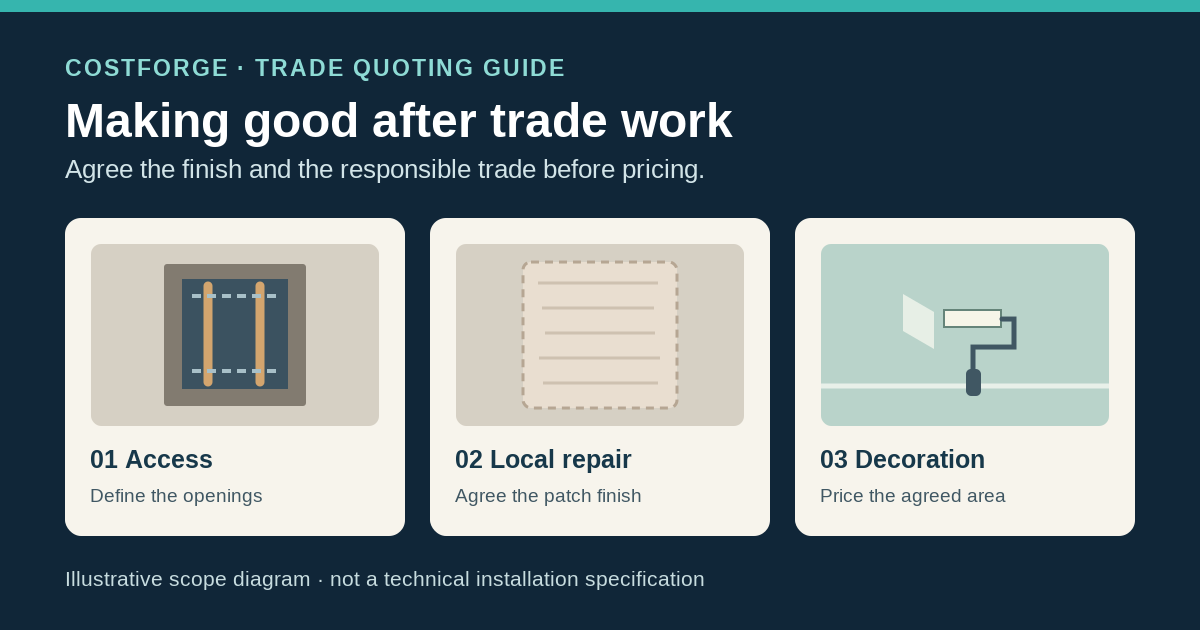
Making good in a trade quote means restoring the parts of a property disturbed to carry out the agreed work. Price the access and reinstatement as separate tasks: identify the surfaces affected, agree the required finish, allocate responsibility to the right trade, and allow for labour, materials, protection, waste and return visits. Do not assume that patching a wall includes repainting it, or that lifting a floor includes replacing damaged flooring.
This matters when an electrician opens a wall for cables, a plumber needs access to a concealed pipe, or a small builder coordinates both. The customer is buying the completed result, not just the installation. A clearly described handover condition allows everyone to compare the price against that result.
1. Start by recording what will be disturbed
Before estimating, walk the intended access route with the customer or principal contractor. Photograph the existing finish with permission and note which surfaces are sound, already damaged or difficult to match. Record the number and approximate dimensions of openings where known, the substrate, and whether the work is in an occupied room.
For example, a pipe repair could need access through plasterboard, a removable panel or a tiled enclosure. Each option has a different reinstatement cost. The least expensive route to the pipe is not necessarily the least expensive finished job. Discuss alternative routes before settling on the scope, subject to the technical and safety requirements of the installation.
For electrical work, the UK electrician quote template gives you a starting structure for separating installation, testing, exclusions and terms. Add a distinct reinstatement section rather than hiding everything under a single labour line.
2. Agree the finish, not just the phrase “making good”
There is no single finish that the words “making good” describe on every job. Write what you intend to leave behind. These are useful commercial distinctions, not technical specifications:
- Access only: the agreed opening is made safely, the service work is completed, and responsibility for subsequent reinstatement is allocated explicitly. Any necessary safety measures remain included.
- Local patch: close the defined opening and repair the affected surface locally. State the expected condition and whether further finishing is required.
- Finish-ready surface: include the agreed preparation and finish to suit the intended subsequent covering. State who checks and completes the preparation after drying.
- Decorated or tiled finish: identify the actual surface area, agreed paint system or tile specification, supply responsibility and any limitations in matching existing materials.
A local plaster repair and a whole-wall repaint are different quantities. A new tile may not match the colour or thickness of an old tile, even if the nominal size is the same. Where matching is important, obtain agreement on the sample or alternative before quoting a final finish.
Do not confuse decorative restoration with essential technical work. The relevant competent trade must establish what reinstatement is needed for safety, moisture protection, fire performance or other requirements. A decorating exclusion is not a reason to leave required safety work unfinished.
3. Break the cost into activities and visits
Give the estimator a checklist that reflects the order of work, not a flat percentage added to the installation cost. Include protection and furniture handling where agreed, access preparation, closing openings, patching, finish preparation, clean-up, disposal and any return visit. Estimate person-hours, including time that is necessary but does not produce a visible finished surface.
Check what is already included in the main installation quote. If the electrician has priced protection and waste removal, do not include the same provision again in the plastering package. If a separate decorator will return after the surface dries, allow for their mobilisation and confirm who arranges access.
Use the UK labour cost calculator to estimate your internal labour input. A cost rate is not the customer selling rate. Include overheads once, using a method appropriate to your business, then choose a selling price. For a check on the arithmetic, use the markup and margin calculator once all relevant costs have been included.
4. Worked example: reinstatement after a small electrical alteration
Suppose the agreed electrical scope in an occupied home includes two local wall openings. The electrician has already priced the installation, testing, safe access and initial protection. The customer wants the affected patches repaired to an agreed finish-ready condition, but will arrange painting separately. The contractor has surveyed the substrate, confirmed the technical requirements and arranged a finishing trade.
The following numbers are fictional estimating assumptions, not market rates, a customer case study or a promise of the time needed on a real property. Costs are assumed to exclude recoverable VAT. The finishing package includes local materials and a return visit, but does not duplicate the electrician's access or initial protection allowance.
- First finishing visit: 3.5 person-hours at an internal cost of £32 per hour = £112.
- Return visit for agreed finish preparation: 1.5 person-hours at £32 = £48.
- Repair and finishing materials: £48.
- Additional travel and local protection/clean-up consumables: £22.
Total direct cost is £230. Add £30 of allocated business overhead not already in the labour rate, giving an estimated cost of £260. With a chosen 25% markup on this complete modelled cost, the selling price is £325 before VAT. The £65 difference is 20% of that selling price, before unmodelled costs and tax; it is not a verified net profit.
Assume the contractor is VAT-registered and this particular domestic repair is standard-rated. At 20%, VAT is £65 and the additional customer price is £390 including VAT. A different tax treatment changes the calculation. HMRC guidance on VAT for builders explains the general rate and exceptions; confirm the treatment for the actual supply and contract. A business not registered for VAT must not charge it as VAT, and irrecoverable input tax may be part of its own costs.
If the electrical installation was separately quoted at £900 before VAT on the same assumed tax basis, the combined total would be £1,225 before VAT and £1,470 including VAT. If the contractor omitted the £325 selling-price reinstatement package but still incurred its £260 estimated cost, the contribution from the original job would be reduced by that cost. This is why the boundary belongs in the quote before acceptance.
5. When a plumbing job needs another trade
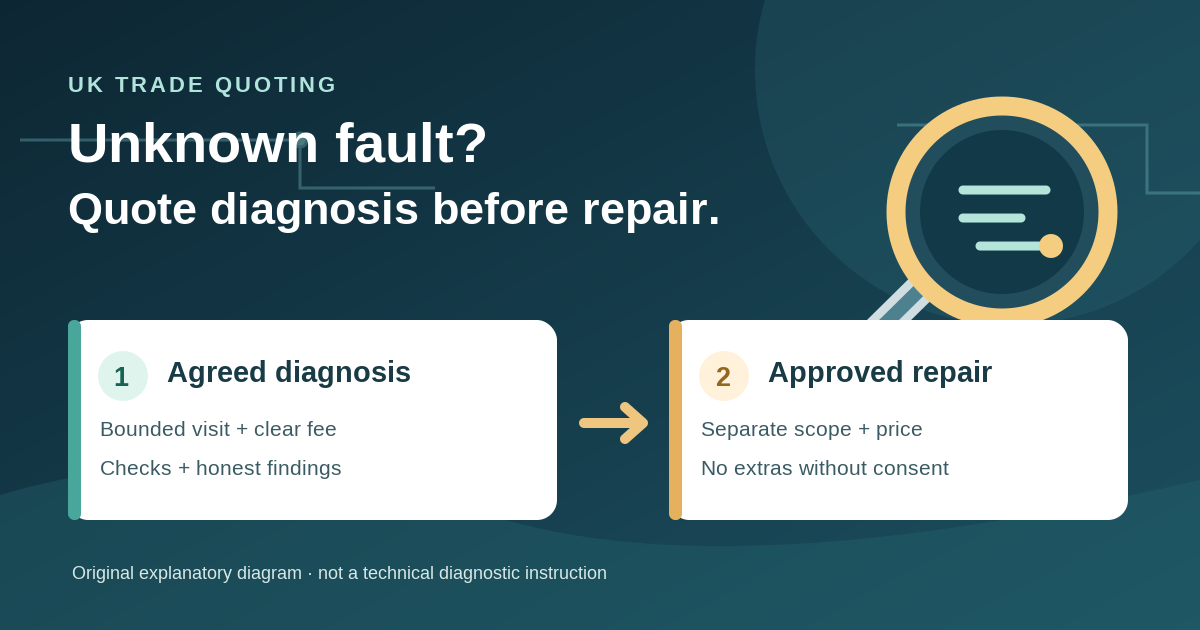
Imagine a leak behind a tiled bath panel. If a panel can be removed and reinstalled intact, the access and finish costs may be relatively predictable. If matching tiles cannot be confirmed or the condition behind the enclosure is unknown, a fixed price for a complete tiled finish may be premature.
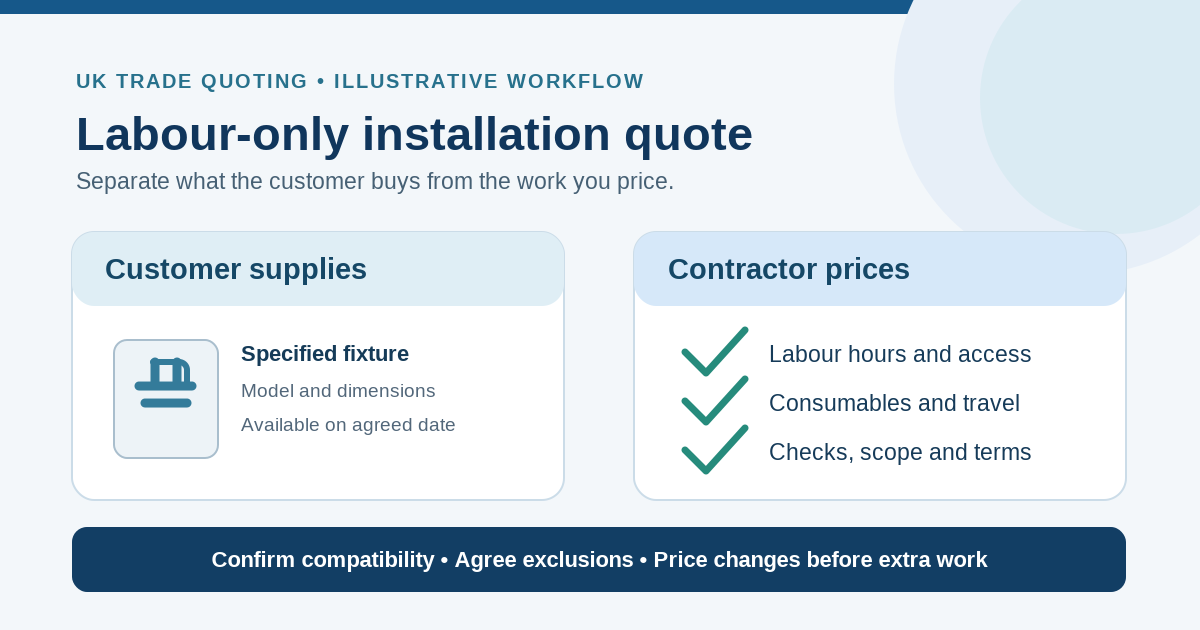
Quote the known service and access tasks, describe the proposed handover condition, and obtain a separate tiler's or builder's price for the defined restoration. If the customer contracts directly with another trade, name that responsibility and agree the handover. If you are supplying the subcontractor, include their price, coordination time and commercial responsibility in your own estimate. Do not silently transfer work that your customer reasonably expects you to deliver.
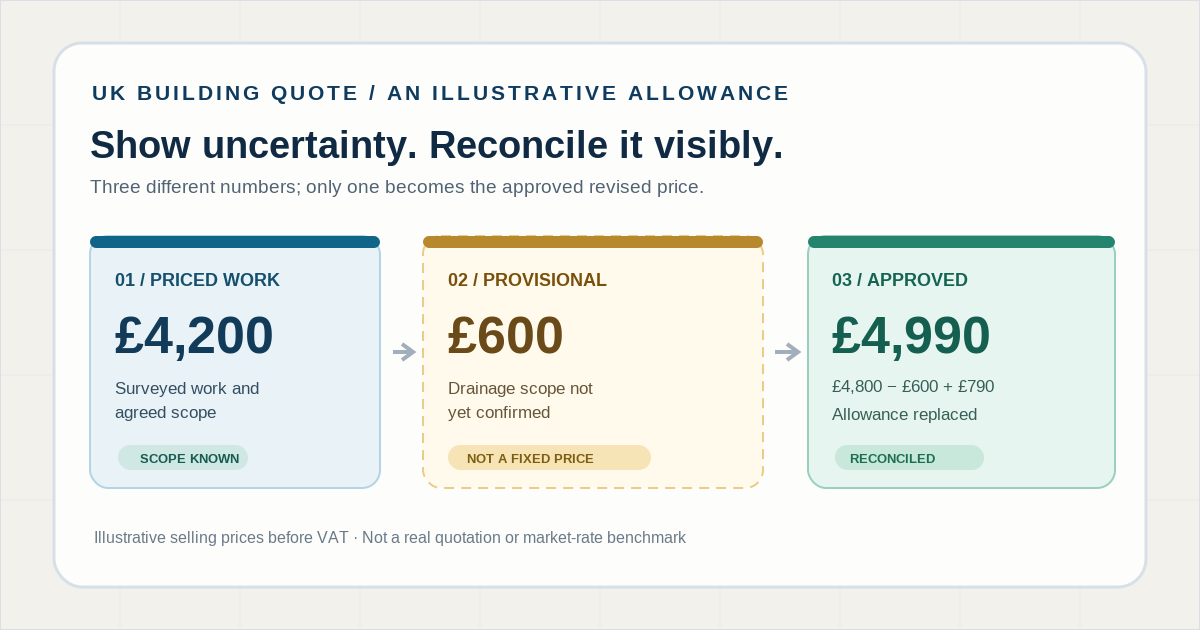
If the extent of a particular restoration task cannot yet be established, use a properly described allowance or a separately agreed stage rather than presenting a guessed amount as fixed. The provisional sums guide explains how to replace an allowance with an agreed figure without charging for it twice. The building variations guide covers additional work and written approval.
6. Put the handover condition into the written quote
For the electrical example, wording might read:
Reinstatement: repair the two identified wall openings in the hall and bedroom to the finish-ready condition agreed at survey, including local preparation and one planned return visit. Painting, wallpapering and whole-wall skim coating are not included. The customer will arrange decoration after the agreed surface condition has been reached. If an unforeseen substrate issue requires extra work outside this scope, we will explain it and agree the changed scope, price and timing before proceeding where safe and practicable.
Use wording that reflects the actual agreement. Do not use an exclusion to avoid correcting damage caused by careless work or to remove statutory consumer rights. Section 49 of the Consumer Rights Act 2015 requires services under consumer contracts to be carried out with reasonable care and skill. Seek appropriate advice if there is a dispute about responsibility.
Safety is not negotiable. Before opening walls or other building fabric, establish whether asbestos may be present and ensure the work is planned and carried out by appropriately competent people. HSE's worker guidance on asbestos explains why older buildings and refurbishment work deserve particular attention, including stopping work if asbestos is unexpectedly disturbed. The pricing allowance is not an asbestos assessment or permission to proceed.
7. Check the whole quote before it goes out
- Identify exactly which areas and existing finishes will be disturbed.
- State the agreed handover condition and the party completing each remaining task.
- Allow for materials, protection, waste, travel and visits without double-counting.
- Confirm the technical requirements with the relevant competent trade and allow for drying or handover time.
- Separate specified fixed work from genuine uncertainty; explain changes and approval in writing.
- Show the applicable tax treatment and complete customer price.
CostForge supports connected client and job records, nested quote items, staff-role hours, branded quote PDFs and sending quotes for a signed online decision. You can use a separate quote section for reinstatement while retaining detailed internal cost items. It is not a technical specification or site-safety system. If that quoting workflow fits your business, Create a CostForge account.
The most useful test is simple: could another trade, the customer and your own estimator read the quote and agree on what the property should look like at handover? If the answer is no, describe the finish and responsibility before agreeing the price.