A provisional sum in a UK building quote is an allowance for a particular piece of work that cannot yet be priced accurately. It is not a firm price for that work and it should not be presented as one. Show what is known, the amount allowed, what information is missing, how the final amount will be agreed and what happens to the total when the allowance is replaced.
For a small builder, this might be a drainage diversion awaiting a survey, reinforcement behind a wall that cannot safely be inspected yet, or a specialist package awaiting design. It is different from a standard cost contingency and from a customer choosing a more expensive fitting. This guide focuses on writing a transparent customer quotation, not reproducing a formal bill of quantities or substituting for the actual contract. All figures are illustrative, not UK market rates or a real customer case.
1. Know when an allowance belongs in the quote
Price work firmly when the relevant quantity, specification, access and method are sufficiently known. If the customer requests a new internal doorway and you have surveyed the wall, measured the opening, obtained any necessary design input and scoped the finishing, those known items should not be hidden behind a vague “provisional works” line.
An allowance becomes useful when an identified work package is likely to be needed but its extent genuinely depends on a future fact: for example, whether an existing drain needs rerouting once the route is exposed. State the unresolved fact beside the allowance. If the work is not authorised or cannot yet be described even approximately, consider excluding it pending investigation rather than showing a deceptively precise sum.
The RICS NRM 2 measurement rules distinguish defined from undefined provisional sums in formal bills of quantities. A defined sum needs information about the nature, location, extent and limitations of the work; an undefined sum lacks some of those details. RICS also treats overheads and profit separately in that formal BQ approach. Do not assume that terminology automatically determines the treatment of an informal domestic quote: the actual agreement must spell out the price basis and approval process.
2. Separate provisional work from prime cost items and contingencies
Three similar-looking entries answer different questions:
- Provisional work allowance: “Allow for possible diversion of an existing drain; route and quantity to be established after inspection.” The work itself is not fully scoped.
- Product selection allowance: “Allow a stated supply budget for wall tiles, final product to be selected.” In formal measurement, a prime cost (PC) sum generally concerns goods or materials, with fixing and other additions accounted for elsewhere. In a household quote, spell out whether delivery, wastage and fitting are included rather than relying on the label.
- Business contingency: An internal reserve for risks you choose to carry in your pricing. It should not be disguised as a customer-authorised blank cheque for unspecified extra work.
One word cannot replace the contract details. For instance, if a tile allowance covers supply only, say how many square metres and what unit cost it assumes, who pays for waste and delivery, and where installation labour is priced. For a deeper method of assembling the known work, use the builder quote template as a scope checklist.
3. Give every provisional entry five pieces of information
A useful allowance has: (1) a named work package; (2) an initial quantity, rate or reasoned amount where possible; (3) the unresolved survey, drawing, selection or opening-up decision; (4) an explicit statement about whether labour, materials, overhead, profit, preliminaries and VAT are included; and (5) a written process for agreeing the replacement price before the work proceeds.
A vague line such as “Provisional works — £600” leaves the customer guessing whether £600 is a ceiling, a deposit, or a price to be added again later. Better wording is: “Indicative allowance of £600 before VAT for a possible short accessible drainage diversion; final route, length and price subject to survey and written approval. No diversion work authorised under this allowance alone. The £600 is replaced, not added to, any subsequently agreed price.”
If a programme impact is possible, identify it. Work whose scope cannot be planned might require additional access, specialist visits or time; do not silently imply those costs are included if they are not. The price and programme consequences of changes depend on the agreed terms, not on a generic blog definition.
4. Worked example: drainage uncertainty during a small renovation
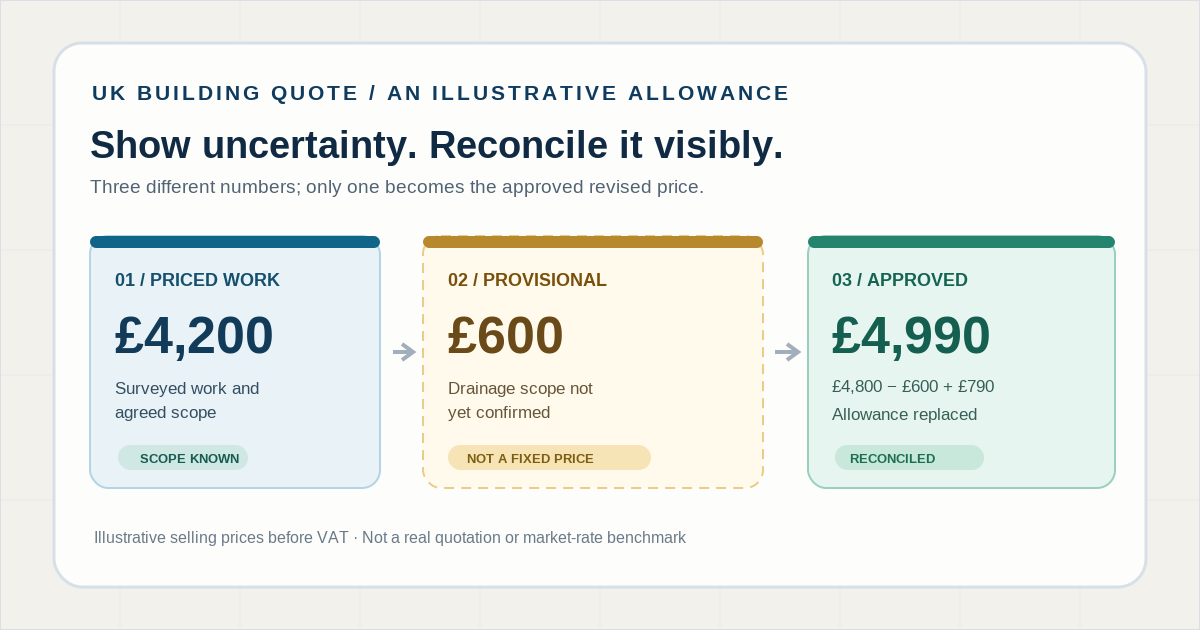
Illustrative scenario only: A builder quotes a modest utility-room refurbishment in an occupied UK home. The visible strip-out, new finishes and fit-out can be scoped, but a concealed drain might require diversion after a planned inspection. Assume all figures below are selling prices before VAT, each containing the specifically stated labour, material, business overhead and profit components as applicable. This is a simple domestic quote, not an NRM 2 bill of quantities.
| Quote line | Commercial treatment | Amount ex VAT |
|---|---|---|
| Surveyed, priced refurbishment work | Agreed scope and price | £4,200 |
| Possible drainage diversion | Provisional allowance; not yet authorised as fixed work | £600 |
| Initial indicative total | £4,200 + £600, subject to the stated allowance | £4,800 |
| Replacement drainage price after inspection | New, fully described price agreed in writing | £790 |
| Remove original allowance | Deduct £600; do not charge it again | −£600 |
| Add approved replacement price | Add £790 for the actual authorised scope | +£790 |
| Illustrative revised total | £4,800 − £600 + £790 | £4,990 |
Only the last two adjustment rows are changes to the indicative total. The difference is £190 before VAT, not £790 extra. If investigation shows that no diversion is necessary, the £600 would instead be removed and the illustrative total would be £4,200, assuming no other agreed changes and no separately priced investigation work. Describe the investigation fee separately if it is chargeable.
If the transaction is standard-rated and the builder is required to charge VAT, an illustrative 20% on £4,990 is £998, giving £5,988 inclusive. VAT treatment depends on the specific work and circumstances; GOV.UK guidance on VAT for builders explains that exceptions exist. Do not apply a universal rate or imply that an allowance is VAT-free simply because it is provisional.
5. Price the uncertainty rather than inventing a fixed scope
Estimate the known portion using task-level labour hours, current supplier prices, access, waste, plant, subcontract quotes and overhead recovery. For the uncertain package, record the basis of the allowance and the facts that will change it. A £600 entry without any supporting assumption is weak even if it happens to be close to the eventual price.
Check that overhead and margin are not charged twice. If your domestic allowance is expressed as an all-in potential selling amount, explain that. If you are preparing a formal BQ to NRM 2, follow the BQ's separate overhead/profit treatment rather than mixing methods. The labour cost calculator can help build realistic hours and business recovery, while the markup and margin calculator distinguishes an uplift on cost from margin on the resulting selling price.
Keep a short allowance schedule for bigger jobs: each line's original amount, reason, decision owner, information required, date of review, replacement amount and approval status. That is useful even if you use a simple spreadsheet or quote document rather than a dedicated contract administrator.
6. Obtain approval before replacing the allowance
When the survey or opening-up produces facts, stop and explain the actual scope. Provide an itemised replacement price: for example, a measured drainage length, fittings, excavation or access, reinstatement, waste and testing as appropriate. Identify any change to the programme and distinguish it from already contracted work. Ask the client to approve the updated amount in writing before doing the uncertain work, unless a separately agreed emergency arrangement applies.
Show the reconciliation as original allowance deducted + replacement scope added. If the replacement is lower, the arithmetic should move down as well as up. Keep the customer-facing comparison and approval with the job's quote records. The separate guide to pricing and approving building variations goes deeper into managing a change after the initial agreement; this article is about exposing uncertainty before the work is finally priced.
Citizens Advice guidance on problems with home improvements distinguishes agreed quotes from estimates and explains why consent matters when the price changes. Do not assume a line labelled “provisional” overrides consumer law or gives an automatic entitlement to extra payment. For complex contracts or a dispute, check the actual terms and take appropriate professional advice.
7. Example wording for a customer quote
Adapt those words to the actual job. Do not promise you can stop part-way through unsafe or regulated work merely because a financial approval has not arrived. Where urgent safety, building-control, insurance or professional obligations affect the programme, the right scope and authorisation process require separate assessment.
8. Pre-send checklist for builders and subcontractors
- Have you separated surveyed fixed-price items from genuinely unresolved work?
- Does each allowance name what is included and which fact will resolve it?
- Have you shown quantities or assumptions where reasonably possible?
- Is it clear whether overhead, profit, programme time, preliminaries and VAT are included?
- Have you distinguished provisional work from product selection allowances?
- Can the customer see how the allowance will be removed and a new price substituted?
- Is written approval required before additional work, and who records it?
- Are exclusions and known access or safety constraints described without evading statutory duties?
- Does the overall total clearly say which part is firm and which is indicative?
CostForge supports client and job records, detailed quote items, staff-role hours and rates, internal margin calculations, branded quote PDFs and signed customer accept-or-decline responses. It is a quoting and commercial workflow tool, not a substitute for a construction contract or a full accounting or project-management suite. To organise scopes and client quote approvals, Create a CostForge account. Review current subscription details separately on pricing.
The principle: a provisional sum should make an uncertain portion of the work easier to see, price and approve—not make an uncertain quote look fixed. Label it, define its basis, replace it transparently and obtain the customer's decision before the extra work starts.