A labour-only quote prices the work you will carry out, not the products the customer buys. For a UK plumber, electrician, bathroom fitter or builder, that still means costing site time, testing, fixings, consumables, travel, overhead and the risk of an extra visit. It also means stating who will check that customer-supplied items are suitable and what happens if they arrive late or do not fit. “Labour only” should never be an unexplained single number.
In a typical customer-supplied installation, the customer chooses and pays for a fixture directly, while the contractor quotes to fit it to a specified existing system. This guide explains a practical pricing method, a worked UK example and the wording worth putting in writing before the work is accepted. All numbers below are illustrative calculations, not UK market rates or a real customer case.
1. Define the installation before estimating hours
Start with the item, location and existing conditions. A request to “fit my new tap” could mean swapping an accessible compatible tap with working isolation valves, or altering pipework in a cramped cabinet. Those are not equivalent scopes. Record a site survey or photographs where appropriate; photographs alone may not reveal hidden access or condition issues.
Write the actual tasks: isolate supplies, protect surfaces, remove the existing item if included, fit the new customer-supplied item, connect to existing services, carry out suitable checks or tests, clear your own waste and hand over. For electrical or gas-related work, make sure the contractor's competence, registration and testing requirements fit the actual job; customer ownership of an appliance does not remove safety obligations.
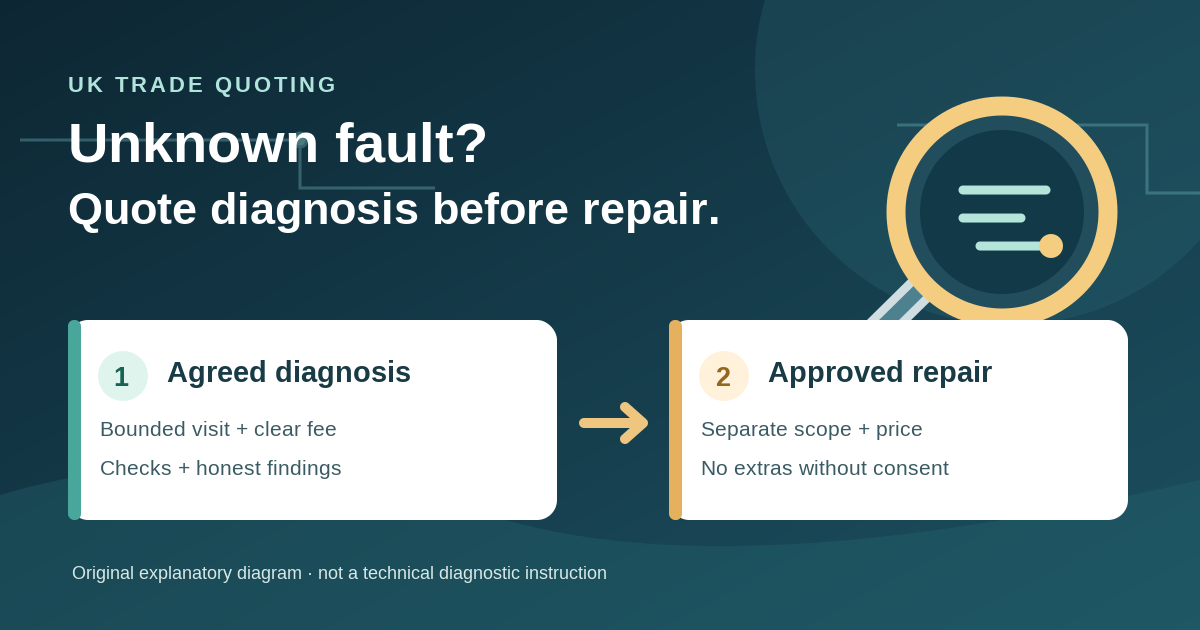
State the starting assumption in terms the customer can check: for example, “Existing connections are accessible, sound and compatible with the supplied tap; no concealed pipe replacement or finishing work is included.” If that cannot be established, consider a separately scoped investigation rather than offering an unjustifiably fixed price.
2. Separate what the customer supplies from what you supply
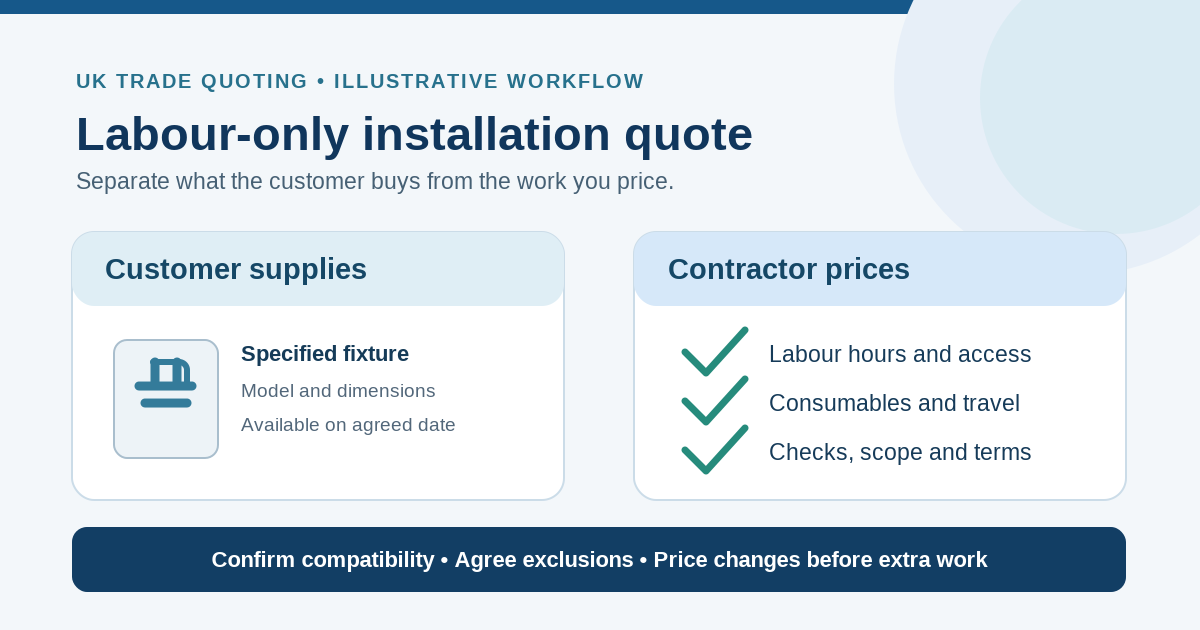
A clear labour-only quote has two columns in the contractor's thinking, even if the finished document uses plain paragraphs. The customer supplies the named product and any specific accessories agreed in advance. The contractor supplies installation time, appropriate tools, ordinary minor consumables and any identified fittings or materials included in the quote. Do not assume the phrase “labour only” means you can work without fixings, sealant, protection or test materials.
Ask for a model number, dimensions, installation instructions and a delivery date before confirming the price. Check compatibility with existing pipework, electrical supply, wall structure or other relevant conditions. If compatibility is not knowable before attendance, describe the uncertainty and agree a decision point. State clearly who will handle returns or replacement of a faulty product; do not promise to resolve manufacturer or retailer problems that you have not agreed to take on.
For a reusable written structure, the UK plumber quote template provides scope, assumptions, installation and testing fields. Adapt them for other trades rather than copying the plumbing example as a universal specification.
3. Cost every hour the installation uses
Break the work into observable tasks: survey or measurements, collection of any contractor-supplied consumables, travel where included in your model, site setup, protection, removal, installation, adjustments, testing, clean-up and customer handover. Put a sensible allowance against each task, then consider whether poor access, working in occupied premises or coordinating with another trade adds time.
Use your internal labour cost rather than mistaking the amount you want to charge the customer for your cost. For employees, consider employer costs and paid non-productive time; for a sole trader, estimate the commercial cost of time consistently. The labour cost calculator can help check hours, direct hourly cost, overhead and travel allowances before a selling price is chosen.
Allocate business overhead once. If your hourly labour figure already includes van, insurance, equipment and administration, do not add those same costs again as a separate overhead allowance. If it is direct labour only, include a defensible allocation elsewhere in the estimate. Then choose a markup or margin based on your business and the job's risk, not an unsupported industry percentage.
4. Worked example: fitting a customer-supplied mixer tap
Illustrative scenario only: A homeowner has bought a suitable mixer tap and asks a plumbing contractor to replace an existing accessible tap. The contractor's model includes the removal and connection, checks, minor installation consumables and a normal visit. There is no charge for supplying the tap because the homeowner buys it directly. The following figures are fictional, exclude any VAT and are not recommended charges.
| Internal estimate item | Calculation | Illustrative cost |
|---|---|---|
| Installation, preparation and testing | 7.5 hours × £24 internal direct cost/hour | £180.00 |
| Contractor-supplied consumables | Assumed job-specific allowance | £18.00 |
| Travel and parking | Assumed direct job cost | £22.00 |
| Business overhead allocation | Not already included in £24/hour | £45.00 |
| Total modelled cost | £180 + £18 + £22 + £45 | £265.00 |
| Illustrative markup on cost | 20% × £265 | £53.00 |
| Proposed selling price before VAT | £265 + £53 | £318.00 |
The £53 difference is 20% markup on cost, but only about 16.7% of the £318 selling price. It is not a 20% gross margin. The example assumes all relevant costs have been identified. If the contractor intends a 20% margin instead, the illustrative price would be £265 ÷ 0.80 = £331.25 before VAT. Use the markup and margin calculator to compare the two methods before putting a number in a real quote.
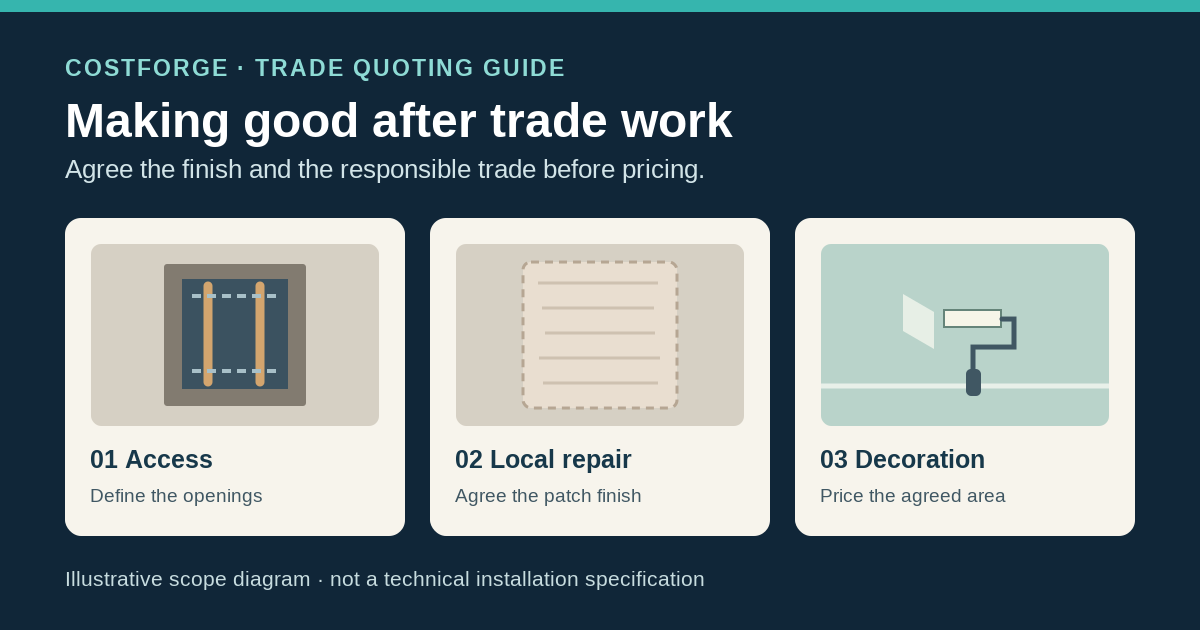
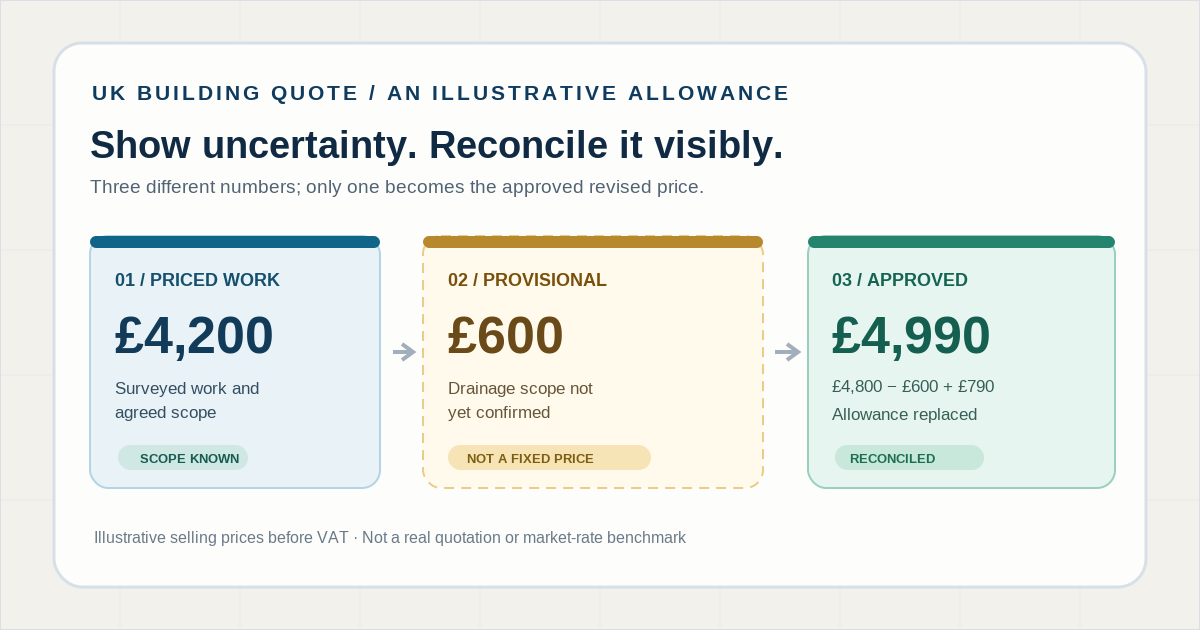
If a fixture is defective or incompatible when the installer arrives, neither this time estimate nor the price necessarily covers dismantling walls, sourcing a new product, or a second appointment. Explain that possibility before the customer accepts, rather than turning an open-ended risk into an undisclosed charge.
5. Put responsibilities and exclusions in the customer quote
The customer-facing document should be understandable without showing every internal cost. One practical structure is: “Remove existing accessible mixer tap; fit customer-supplied replacement to compatible existing supplies; connect, check for leaks and leave the work area tidy. Customer to provide the named tap and manufacturer's fittings by the agreed installation date.” Add the location, price, VAT treatment, timescale and acceptance method.
List the exclusions that genuinely matter: unsuitable or damaged customer-supplied products, hidden defects, additional pipework, modifying cabinetry, tiling or decorating, extra visits caused by late delivery, and unrelated remedial work. Do not use a blanket “all risk is the customer's” clause. Spell out how extra work would be assessed and approved, and do not begin chargeable changes without the appropriate agreement. For a more general approach to revisions, see the guide to pricing and approving building variations.
For work with consumers, the Consumer Rights Act 2015, section 49 requires services to be carried out with reasonable care and skill. Section 57 restricts terms that try to exclude that liability. An exclusion describing work you have not agreed to supply is not the same as excluding responsibility for negligent installation. The legal position depends on the contract and facts; obtain advice for disputed or high-value jobs.
6. Explain delays, reattendance and changes before work starts
Customer-supplied products introduce a dependency you do not control. Ask the customer to confirm delivery and check the package before you reserve a final installation appointment. Describe how much notice is needed if the item is delayed, whether an aborted visit could attract an agreed charge and how a rebooking would be priced. Any such term must be clear, fair and appropriate to the circumstances; do not treat it as an automatic penalty.
Where a measurement or a first-fix inspection is necessary before ordering, make that a distinct agreed stage. Keep the product model and revision in the file, so a last-minute substitute does not silently alter the work. If the customer changes the scope, issue a revised quote or separately priced variation. Confirm extra labour, any new materials and the effect on the appointment or completion date before proceeding wherever possible.
7. Treat VAT and payment terms as part of the quote
Show whether the stated price includes or excludes VAT and apply the treatment relevant to the work and the business. Do not assume that customer ownership of the principal fixture, or use of the words “labour only”, determines the VAT rate. Consult current GOV.UK VAT guidance and obtain specialist advice for an unusual construction or installation treatment. The £318 example deliberately leaves VAT out of the calculation.
Set a genuine quote validity date, an appropriate payment point and a clear written acceptance step. If an advance booking payment is proposed, explain what it covers and when it is due. Do not copy an arbitrary deposit percentage from another contractor. Keep the accepted version of the scope and any later changes against the job.
8. A final labour-only quotation checklist
- Specified product: supplier, model, quantities, dimensions and who purchases it.
- Site conditions: access, isolation, existing connections, safety and testing assumptions.
- Included work: removal, fitting, consumables, protection, waste and handover.
- Priced hours: task time, travel, non-productive time, overhead and profit without double counting.
- Exclusions: incompatible items, hidden defects, making good and additional visits stated fairly.
- Decision points: delivery confirmed, changes agreed, quote accepted, VAT treatment and payment terms recorded.
Use a short checklist like this every time, then adjust it to the trade and actual job. For a broader plumbing workflow, the plumbing job quoting guide covers full supply-and-fit quotations as well as labour, scope and exclusions.
CostForge can keep clients, jobs, detailed quote items, labour-role hours and internal margin alongside a branded customer quote and its signed response. It does not replace trade competence, on-site checks, a lawyer or an accounting package. When you have the scope and numbers ready, you can Create a CostForge account to organise the quotation. A link click is not evidence of a completed registration.